I’ve been wanting to create this “How It Started/How It’s Going” picture series for more than a year now. For reasons that weren’t clear in the moment, I felt especially driven to make it happen last week. It now seems to me that might have been the Spirit nudging me about this week’s Gospel lesson: “The Parable of the Mustard Seed.”
First, the pics…
Two pictures, in the same spot, set 31-ish summers apart.
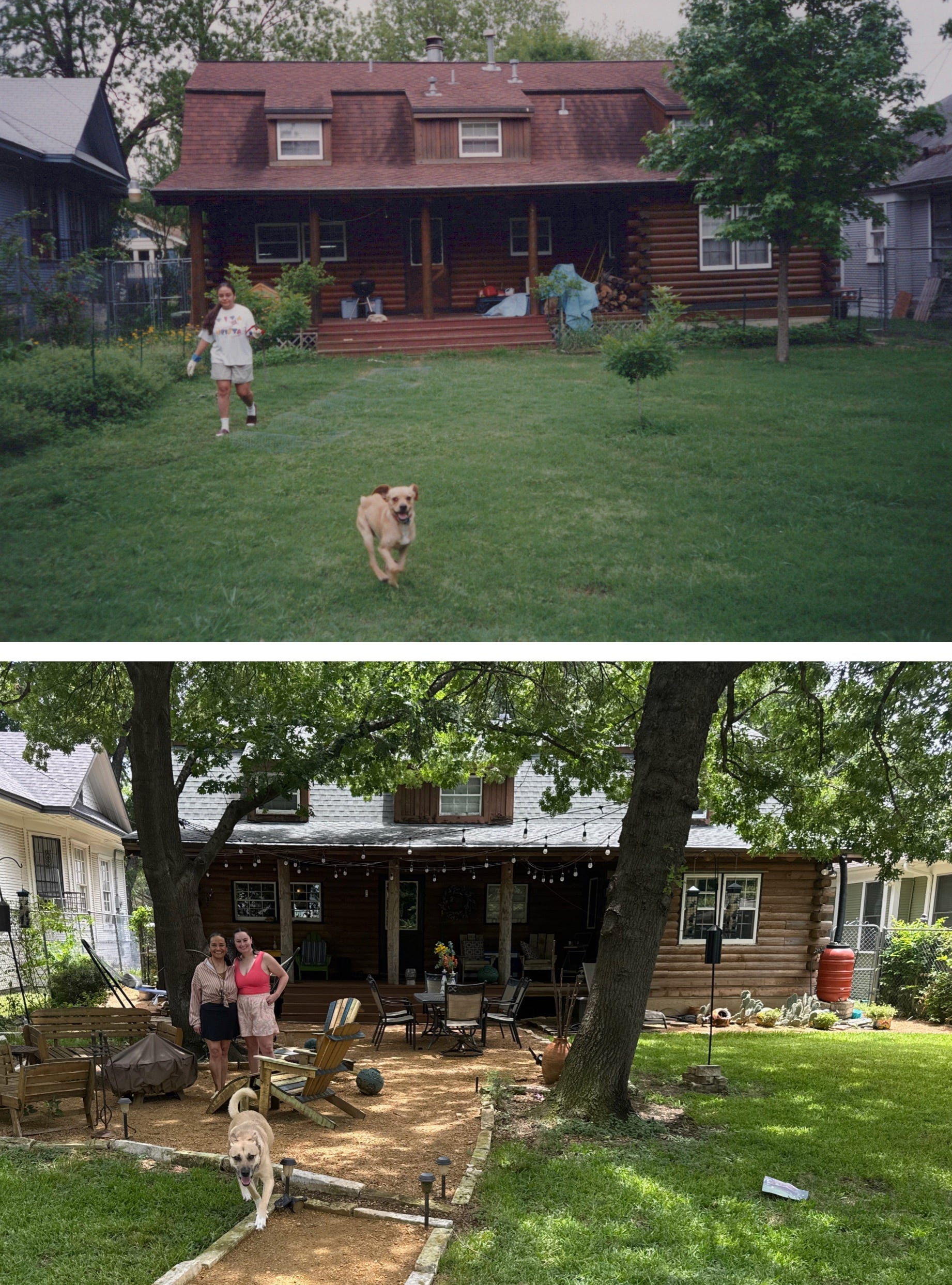
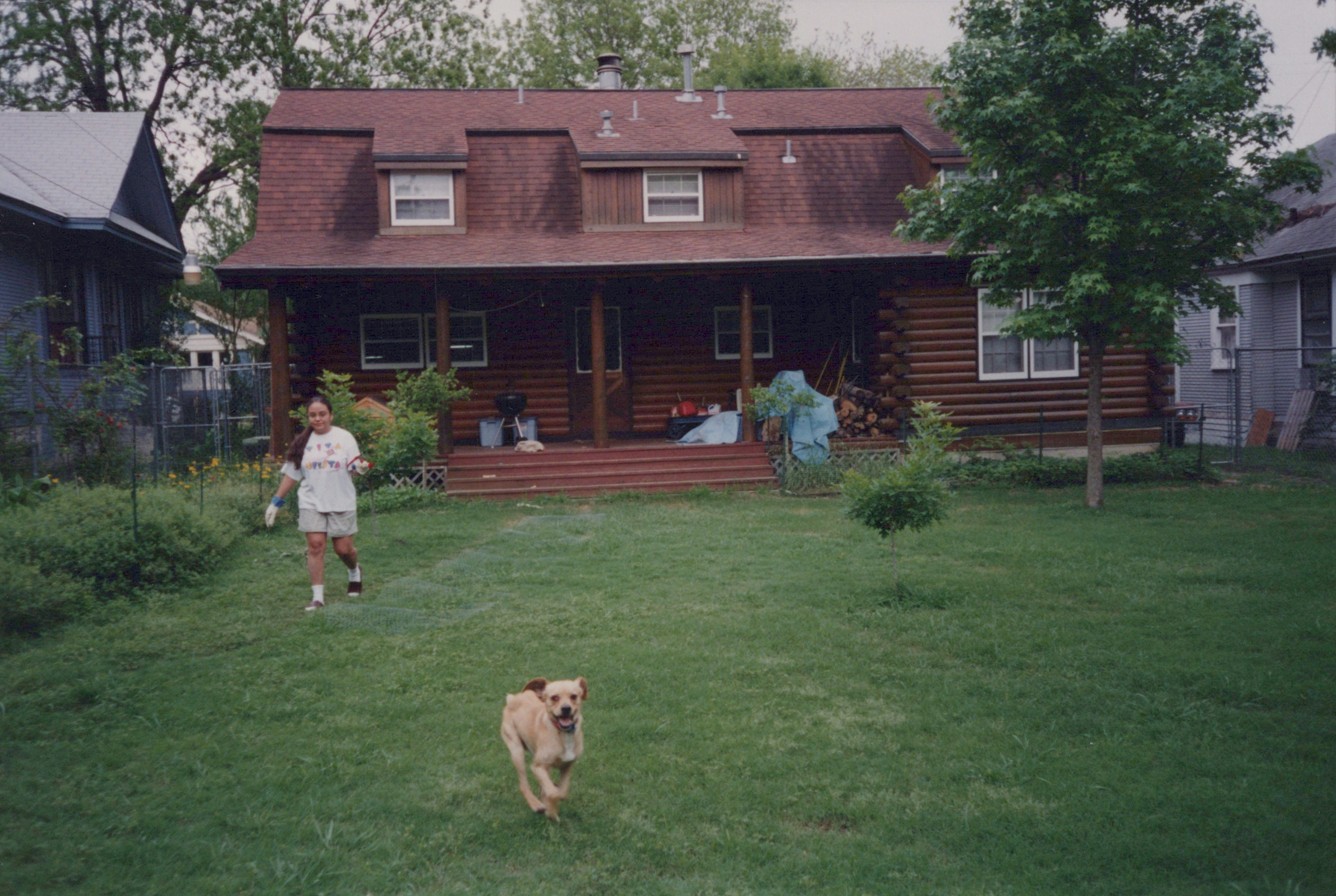
It’s our backyard.
In the first picture, we have been married two years and are young professions —too poor to buy— so we are renting our Loghouse. For many years, the house and shingles both had this kind of deep brown color.
You can the lush, green yard. You also see a long gone tree to the right that died of beetle/bug infestation probably twenty years ago. And you see Dennise (not even thirty-years-old here) and our dog Max.
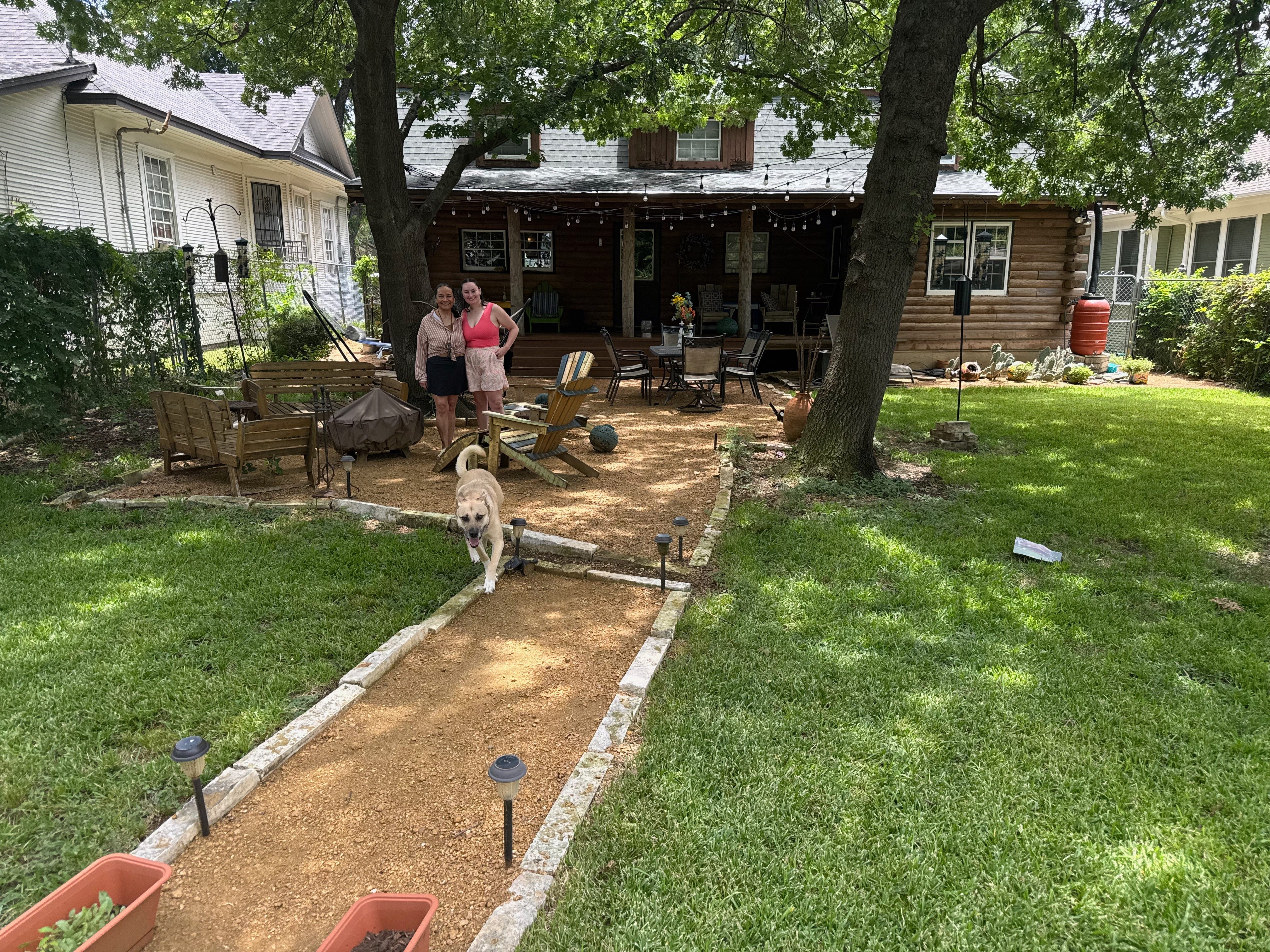
The second picture, as I’ve said, was last weekend. And it reflects remarkable changes. A new dog (Holmes…)…
The incredible patio area and lights that we hung by hand…
And, of course, our daughter (nearly thirty now) who wouldn’t even be born until another two years after the first picture.
But the thing that grabs me the most, the greatest change I personally see, are the two massive oak trees. I’ve written many times of the joy of our three Texas Red Oaks. We have a lone large one in the front year, and these two twins in the back. These two twins shield the house from the worst of the Summer Sun. That blazing Summer Sun sets behind my back, as I’m taking this picture…so the trees make everything in the yard cooler and more tolerable.
But note the point here: Those little shrubs in the first picture?
Those are the stately oaks in the second!
That’s them, a few short years after they were planted. I’m thinking the Odeski family planted them when they moved out of the house, and we moved in the previous year?
No idea…my guess.
But they were tiny. They are an afterthought in that first picture. And now, they are one of the greatest blessings of our life, as I sit with my morning coffee in their shade. Busy squirrels, dozens of birds species, all find shade in their branches.
This week’s Gospel lesson, Jesus teaches the same lesson of these pictures:
“The kingdom of heaven is like a mustard seed that someone took and sowed in his field; it is the smallest of all the seeds, but when it has grown it is the greatest of shrubs and becomes a tree, so that the birds of the air come and make nests in its branches.”
Mustard seeds really are tiny. If you saw one on the counter, you might fear that your dog had fleas.
They do not grow into the most massive of all trees. But Jesus’ point is solid, because Jesus’ point is about growth, trust, and time. Jesus is reminding us we are called to trust in the creative, growth-centered, power of God’s Spirit.
At heart, growth takes trust and faith that something you cannot control —perhaps beyond the event horizon of your own life— is possible.
This is the third agricultural parable in a row in the lectionary.
Week One was “The Parable of the Sower,” which reminds us to embrace equanimity. There is “good soil,” and there is “rocky ground,” and our calling is to simply sow seeds in trust and faith.
Week Two was “The Parable of the ‘Wheat’ and ‘Tares,’” a reminder that it is not our job to weed human beings out. God calls us to live together with all people, loving them as we can, even if they differ from us. Weeding is God’s job, and when we do it it’s often an example of our human hubris, not God’s calling. (Essay here)
This week’s parable, like those two pictures, reminds us that we are not in control of any of it, that none of it happens on our timeline. But that trust in God, faith in process-over-time, is one of the greatest blessings of the spiritual life.
There is so much wrong with our world, right now.
I shall not list off everything, but you know that this is true.
When life is stressed and we are anxiety-ridden, we can want quick fixes. But some things are only changed by trusting in the growth, over time.
I keep coming back to mid-century theologian, Reinhold Niebuhr, and his deeply brilliant “Christian Realism.” Niebuhr certainly saw the evils of his own time. He would see his German friend, and former student, Rev. Dietrich Bonhoeffer, be murdered by Hitler as part of the “Confessing Church” in Germany. That was certainly a sobering moment.1
Later, Niebuhr would watch as American power became partisan and hard, and the “Red Scare” pushed our anti-communist tendencies into dangerous “Otherizing.” He saw and responded to the growth of corporate power, and the military industrial complex.
This pushed him to a “Christian Realism” which both works within our current systems and yet is tied to God’s Realm beyond all time and space, as well. And while he embraced American democracy, he did not nationalistically bless it without sober critique.
My favorite Niebuhr quote, then, is not the famous Serenity Prayer, but this one here:
“Nothing that is worth doing can be achieved in our lifetime;
therefore we must be saved by hope.
Nothing which is true or beautiful or good makes complete sense in any immediate context of history;
therefore we must be saved by faith.
Nothing we do, however virtuous, can be accomplished alone;
therefore we must be saved by love.
No virtuous act is quite as virtuous from the standpoint of our friend or foe as it is from our standpoint.
Therefore we must be saved by the final form of love which is forgiveness.”― Reinhold Niebuhr, The Irony of American History
We are saved by hope, faith, and forgiveness. We do our best, in every generation, understanding that the next generations will likely critique and perhaps even lambast our efforts.2
We plant trees that, as the old expression says, we shall never sit underneath. That said, every now and then, if we’re blessed, we get to see pictures like these two I shared here. Or, we can intuit the spiritual truth of Jesus’ parable.
Nothing true, worth doing, or anything beautiful and good, makes sense when we look at an individual tree. We must pull back, and look at the forest.
This is the heart of trust and faith.
This week, I am still reading and digesting a brilliant book that Harvard researcher calls “The Awakened Brain: The New Science of Spirituality and Our Quest for an Inspired Life.”
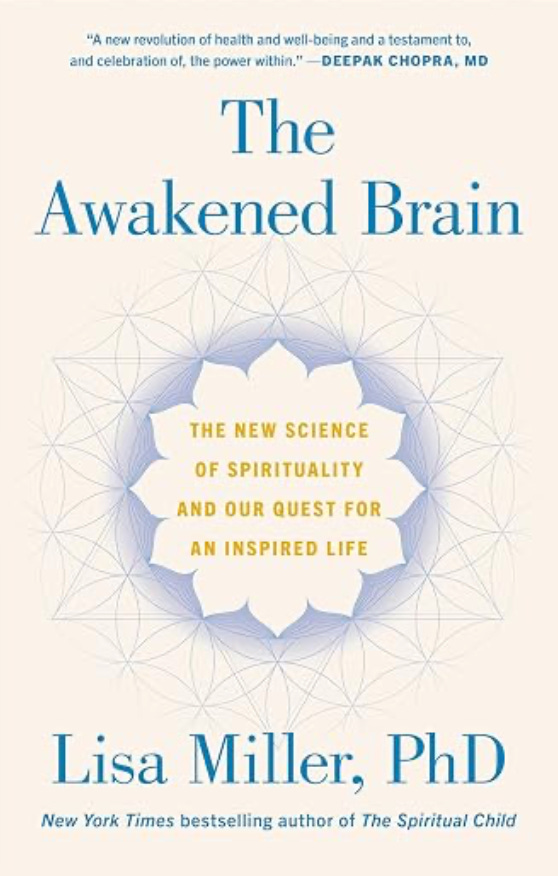
As longtime readers will know, I’m fascinated by the wisdom of brain science and how, it seems to me, it often confirms deep, centuries old mystical truths of our great religious traditions.
That is not to say that religions —church law or doctrine— should be embraced without question. But it is to say what I often say…that these ancient traditions —including Christianity— have at their core a wisdom we humans still deeply need.
One of the key insights of the book is Dr. Miller’s is the distinction between “The Achieving Brain,” and “The Awakened Brain.”
A quick summary is:
Achieving Brain is focused on goals, control, and performance. It acts like a GPS system, constantly asking, “How do I get what I want?”
Awakened Brain is open, intuitive, and receptive. It acts like an antenna, asking, “What is life showing me right now?”
Brain imagery shows us that our brains light up in different areas, depending upon which “brain” we are using in any given moment.
She’s shown, through research, that prayer, meditation, spiritual practice really do light up specific portions of our brains. Further, they produce physical changes in the brain that are protective of things like depression. This is what she calls “The Awakened Brain.”
”Achieving Brain” is goal centered and transactional. It critiques, analyzes and keeps us on a toward tangible outcomes.
”Awakened Brain” is journey-centered. It’s most like writing a song or painting a painting. I believe she is saying it’s connected to creativity and connectedness.
She is not, of course, suggesting that spiritual cures all depression an illness. But she is suggesting that science has undervalued the likely contributions of spiritual practice and life.
This connects powerful with things I have said for many years now:
That spirituality and religion are more an “art” than a “science.”3
That theology has become too closely connected with LOGIC, and failed to help folks develop their own innate trust in the leading God gives us.
That intuition is not always right, but that we modern folks dismiss it far too often.
Nobody here is saying “Be anti science.” But recall how many of the stories of great discoveries (Newton and that apple tree, Einstein and ordinary trolley cars) happened when logical scientists pushed the metaphors that life gave them. When they used their creativity and their logic like they were painters or songwriters, and trusted that metaphors like apples and trolley cars can reveal deeper truth.
My strong hunch, for many years now, has been that our culture has placed a false binary between science and religion. Fundamentalists and Scientists shriek at each other in our public spaces, with claims and counter claims…neither of them really admitting that they're all talking with a “logical brain.” (Perhaps the “Achieving Brain?”)
It seems to me that Jesus’ parable is giving us the gift of reminding us is faith, hope, trust. That, as Niebuhr says, these things take time, patience, and trust.
Again, these are hard lessons in these very times we are in, right now. Nobody has any patience, despite the fact that the Bible describes patience as a spiritual gift.4
Yes, dear God, call for social justice.
Yes, dear God, reject Christian Nationalism.
Sure, reject the parts of your religious upbringing that no longer serve you.
Deconstruct that which does not serve.
But also hear Dr. Miller’s gentle reminder that science shows how spiritual practice itself is an undervalued part of our human experience…at least in much of our culture.
In my way of speaking, it is my Christian faith that both calls me to activism…and also provides the spiritual nurture to deal with disappointment, delay, crushing defeats, and physical/spiritual exhaustion. I often worry about many of my activist friends who reject their spiritual dimension, and try to just “push through” in tough times.
If Christianity is a part of your heritage, it could be that its tenets could still serve you, albeit through a spiritual practice (which may more may not include a traditional church) that can help you in this time.
For me, it’s a kind of neo- Christian Realism. It’s, to quote Niebuhr, “seeing the world as it is…”
It’s trusting the growth of Red Oak trees, over time. Trusting that I don’t control the outcomes, but I do control whether or not I show up for social justice and practice my faith daily.
In the end, thirty year old red oaks teach the same lesson as Jesus’ parable.
That nothing worth doing can be totally seen in any given historical moment. Yes, stop the bleeding and harm of our time, knowing that it is not in your power to change everything. Forgiveness, hope, and faith are all a part of trusting God’s Spirit to create a realm that is both breaking forth now, and will always still on the way. But know that you are, when you show up and speak out, planting trees that others will find shade under, through the mystery of God’s Spirit.
God’s Spirit —that which brings for all human creativity and growth— is creating the shady trees of tomorrow, right now.
Even if all you feel is the brutal the blaze of our world’s hot summer Sun, trust in that process of mystery and wonder; and one of these days, maybe you too will marvel at the trees God has grown for you.
Our own Dallas-based clergy group CLEARDFW (“Clergy League for Emergency Action and Response) is an intentional “call back” to the “Clergy Emergency League” that Bonhoeffer and others founded in 1930s Germany. A precursor to the “Confessing Church” it was the group of faith leaders who stood up to growing Nazi power.
This is also the spiritual genius behind our Methodist rule, given to us by Wesley, to “Do No Harm.” That should be our spiritual call, knowing that we will fail. We will not be wise enough, far-thinking enough, clairvoyant enough, or self-aware enough, to avoid doing harm.
But we should try, and putting that first FIRST…before “Do All the Good You Can” helps us be self-reflective before acting…
Again, we will fail, even when we try to “Do no Harm.” Which is what leads Niebuhr to insists we are all saved by forgiveness.
Or, they should be.
Kudos, again, to and for this brilliant point in the their book, “Loving Disagreement.”