
Unfinished business
Liner notes

(Note: These “notes” are currently in process. Apologies for any spelling or gramatical errors, and happy for you to mention them so I can fix it… Also, ignore the lyrics links for now. I'll fix them soon…EF)
You found the notes!
Welcome!
I lied to you last year.
I didn’t mean to.
It wasn’t really a lie.
Last year, when I put out my album, I told the long and tortured story of lost tracks, and lost songs.
Much of that story is true.
It turns out, it just wasn’t the whole story…
This Spring, I sat down to start work on a new album, a pledge I made to myself last year. The thought was that last year's record cleared the decks for me, allowing me to move on to new songs. (Yes, there are many…)
But, I kept being haunted by unreleased tracks I’d wished had been on the last record.
That sent me to the archives for one last check. And in the back of a closet, in the bottom of a very dusty box, were stacks and folders of burned CDs. Back in the day, before “cloud storage” or removable hard drives, we'd burn CDs of our work at the end of each studio-day, to listen back to. These dusty CDs contained many of the raw studio tracks I believed were lost to time; and a few close-to-done demos, never finished.
I was stunned. Somehow, I’d overlooked/missed all this material. And here it was. Including a shocking number of the actual original studio tracks. In my defense, all these tracks got further work, even back in the day. So, apparently, I just forgot that I had older versions still.
So, it is true: Some material from the past 23 years is indeed gone.
But it's also true that: There was enough here that I owe myself, my past, and these songs the change to finish this unfinished business.
It’s rough in places. A few of these songs are simply cleaned up demos with goofs that can’t be removed, clippy in parts. There’s no way to polish out some of those goofs; and my desire to get release them to the world has finally overtaken my desire for perfectionism and preciousness.
Of note for folk music friends, Rachel Bissex appears on two tracks.
Two years after she recorded these tracks, she would be gone, and she's been gone twenty years now.
Clark Findley, my coproducer and collaborator on almost all of this material, also died last year.
So, as I stared at these old CDs, I thought, Why not honor them, and all they did for me, by putting this out?
This is where my heart landed.
So now…really, truly, this completes my unfinished business.
This is it, I promise.
I hope you enjoy this journey through the past 23 years of my musical life.
Thank you for listening, and for sharing my joy in keeping this promise to myself.

This record is dedicated to Clark Findley.
Clark was my coproducer, engineer, studio owner, teacher, and friend. Most everything I know about music production came from our work together at three studios over half a decade. I have regrets that he is no longer here to see these songs loose in the world. But this record is, in part, his unfinished business too, and my gratitude to him is immeasurable and deep.
Click HERE for the Printed CD Liner Notes.
A few notes about each about each song and the production…
I refer to three studios in the notes. Here are the rough time periods, for your info:
"Phattman Studios, Pleasant Grove (circa 2000-2002)
"Alpha/Omega Studios, Fort Worth (circa 2002-2005)
"Selfish Giant Studios, East Dallas (circa 2015-2025)
(For now, please find all the lyrics HERE, and ignore the lyric links below…)
The Grass Is Only Greener (lyrics)
This is one of three songs on this record inspired by the writings of Rabbi and Therapist, Dr. Edwin Friedman, and his incredible book, “Friedman's Fables.”
The book is a collection of “fables,” ala Aesop's, except that each one is packed with a “moral;” dense with family systems wisdom. They are deep and wise, and I often use them in counseling and small groups. The collection is a desert island book for me.
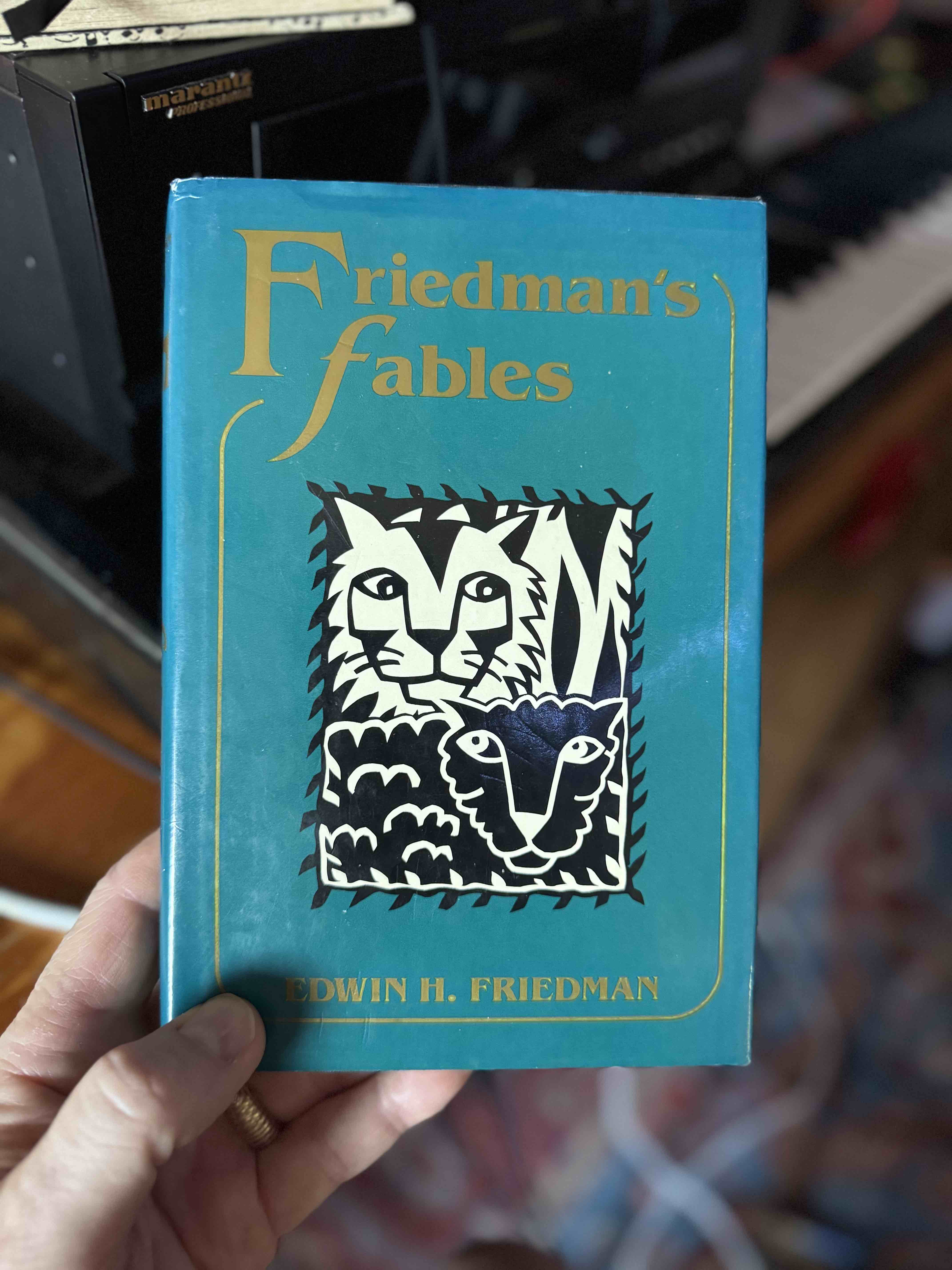
This one is inspired by the short story, “Jill and Jane.”
I won't give away the whole story, because it's a good one.
The book has a study guide that accompanies it, and that guide has a “moral” to each story. The song title is lifted straight from the moral of this story:
“The grass is only greener when you're not caring for your own lawn.”
Said another way, we are all obsessed with being…somewhere else. It was always an issue, even when I wrote the song years ago. But now, our devices allow us to imagine of that pursuit of happiness every waking moment. We're never promised we can catch up to happiness in this pursuit…just that we have the right to work our whole lives dreaming about that greener pasture…somewhere.
Production:
This song is retracked/remastered in 2025 with the original tracks but a new lead vocal and lyrics.
Some of the cultural references were too dated, so the third verse especially, got an update.
There was a piano track recorded by Clark at Alpha/Omega that appears to be gone now.
Kevin Moore's bass is absolutely amazing, and Carlyle McCullough's percussion pulls it all together.
All tracks beside the lead vocals were recorded at “Phattman” studio.
Those Two (lyrics)
A song I wrote for Dennise, years ago.
It's looking back and she and me over the years.
This one gets more poignant for us, every year.
Production:
Recorded and tracked at “Selfish Giant.”
Ember Afterglow (lyrics)
A simple song about the joy of song circles. This one was inspired by Kerrville. I am thinking especially of late night at “Crow's Nest,” around the actual embers there…but also my home Camp Nashbill, and many many other beautiful nights with songwriter friends all over those grounds.
I especially like these lines:
"One these nights, it often seems
We're living out, what's in our genes
To tell a story, sing a scene
Around some ember afterglow."
Production:
“Selfish Giant”
You Can Go Home Again (lyrics)
This is a song about the second time we moved into our house.
It was the year 2000, and we'd already fallen in love with this one-of-a-kind log house in East Dallas. But, in '96 we'd moved out of it because we were too poor to afford the rent increase. We stayed in touch with the owners, and a few years later they were sick of being landlords, and called us up to see if we wanted to buy it. By then, our finances were better, and we cobbled together a downpayment.
That had been our dream, from the moment we first walked into it in 1994, and it seemed almost too good to be true.
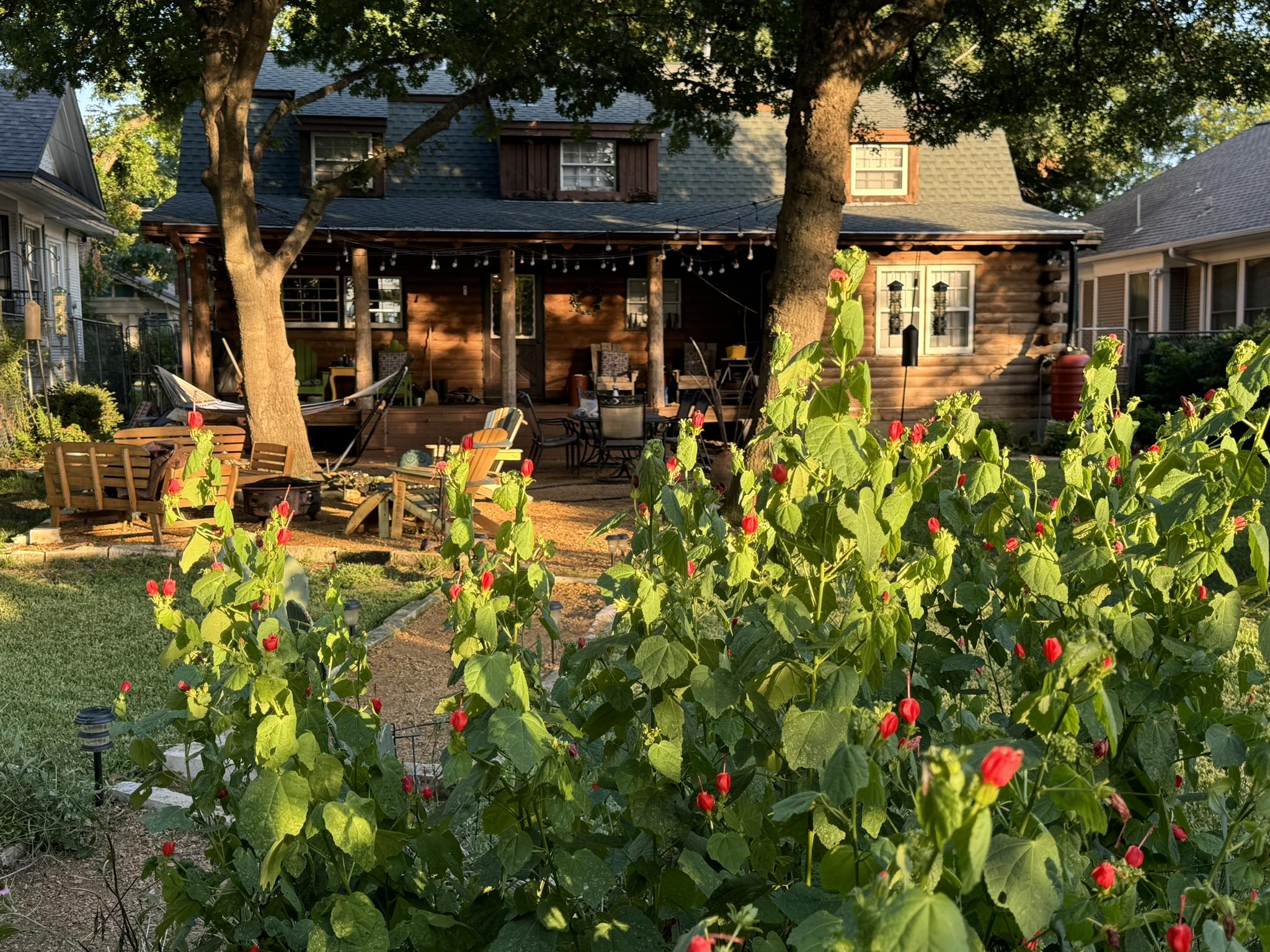
I know we are biased, because we live here. But this one-of-a-kind log house, two miles from downtown Dallas, really is a unique place. And we feel so lucky to get to live here. Many who visit us here comment on how warm and inviting it feels.
We are blessed.
So, the song is a celebration of how, yes, you can go home again.
But…things are always changing, so the trick is to make the “same place” new, every day.
As fate would have it, we would move out of the house yet again…little over a year later!
This seemed like a bad dream, honestly. (And the inspiration of “Return.” Also on the this record…)
We ended up living away from the log house for fifteen years, before we moved back into our house…for the third time. We've now been here close to a decade again on this third stint.
The old “hood” has changed a lot.
So have we.
And so, the song is remarkably resilient.
“Back in the same place…it's not the same…”
Production:
The guts of this song is a demo from the early years recording with Clark. I had no way to recover the back-vocals from Rick O'Connor and Bruce Hathaway. These are part of some truly lost tracks from Alpha/Omega.
Therefore, there are audible goof you can hear in this version. But I just liked their performance too much to redo it.
It's freshened up with some doubled-tracks, and I think turned out ok.
Free My Hands (lyrics)
The second of the three songs, inspired by Rabbi Friedman's book, “Friedman's Fables.”
This song is a close to word-for-word retelling of perhaps his best-known fable, "The Bridge." It captures the action of the fable at the penultimate moment: As the “man on the bridge” tells the dangling “Other” that he has a choice. He can wrap up the rope from his end, because he (the man on the bridge) won't be able to hold that rope forever. Or, the man on the bridge will accept his choice, and free his hands.
This fable is soooo deep. I was in a seminar with Dr. Friedman once. He suggested that it's not just a story about two people and a kind of co-dependence (to use a dated term), but that it also works as an allegory for different parts within an individual human too. That seems right to me.
“The Bridge” is a very deep morality play.
Check it out.
“Free My Hands” gets a lot of request from listeners at live shows, so I'm pleased to have this officially out…finally.
Production:
So, this song is absolutely THE song that inspired this entire record. These tracks with Rachel, and my desire to recover/release them, drove me to look for an archive, and shockingly discover those old burned CDs.
Rachel Bissex was an incredible musician, and an unbelievably kind human. She had a magnetic personality that drew people to her. She was coming through town for a gig in Fort Worth, and needed a portable sound system. So, I made her a deal: She could borrow mine, and I'd even be her roady for the day and drive her over there, if she'd come record a few songs with me too.
We had a blast. She'd never been to Fort Worth, and the cowboy culture was a kick to her.
Tim McLemore adds piano.
(More about Tim later…)
The original tracks, vocals and guitar, were at “Phattman.”
Tim's piano was recorded at “Alpha Omega”.
A Love Song That's True (lyrics)
This song came from my own frustration at not being able to write a good love song, and from feeling like so many of them were “cliche.” There was a period where everything I tried to write just sounded stupid and pedestrian.
So, in my own annoyance, I wrote a cliche love song, about love song cliches.
Production:
Lead vocals, guitar, and Rachel were all recorded at “Phattman.”
That's also Tim McLemore again on piano, recorded later at “Alpha Omega." At the time, Tim was the pastor at Kessler Park UMC in Oak Cliff…where I am the pastor now. (Such is the amazing confluence of my life…)
I used to drive over and pick Tim up, driving the same route I now use to go to work each day. Then, we'd head to Fort Worth, together.
Fun trivia: The piano Tim is playing was a gorgeous ivory-colored grand piano, in the “A Studio.” We were told that the studio had bought it from televangelist Robert Tilton. It gave us great joy to be two Methodist pastors playing the piano of a disgraced televangelist.
The day we recorded the piano part here, I lamented how it need bass. So Tim picked up one from the corner, and popped out the bass part too…in about ten minutes.
And I must say a word about Reggie Rueffer…
I was complaining to Dennise how I couldn't seem to find a good fiddle player for couple of songs.
And she said, “Oh…I know this guy from high school orchestra…”
“Right…” I thought.
Turns out I should listen to my wife. Because Reggie is a world-class musician whose spent years touring the world with the likes of Charlie Pride. (In another small world thing: His family also knows my high school friend, Stu…)
Reggie agreed to come over to Fort Worth and record.
I have a clear memory of the day. He comes into the control room. Listens intently. Takes a few notes on a piece of paper. Then, after hearing the song the one time, looks at me and asks, “Well, do you have any questions?”
I think maybe he did two takes on each of the songs we recorded. They were all gold, like this. In fact, by the end of the hour (he did about four songs in one hour…) everybody from the A Studio, and all over had crowded into the control room to listen to this miraculous sounds coming from his fiddle.
I Wish You Could Cry (lyrics)
Not sure this one needs much explaination.
Sometimes, you can “read” another person's face better than they can see what's happening.
Sometimes, we all just need a good cry. Maybe especially these days.
Production:
Me, at “Selfish Giant.”
Words I Cannot Say (lyrics)
I went into a pretty intense depression for part of my forties. I gained a lot of weight. I was eventually on medication. I've written about it elsewhere. At the time, it felt like there were a lot of words I couldn't say, couldn't process, or couldn't collect into verbal thoughts. It was a lot of conflicting emotion and pain, and it felt like life might be coming apart.
This song came from a particularly dark time, when no words would come.
Production:
All me, at “Selfish Giant.”
Coolest Guy In the Room (lyrics)
An absolutely true story of an absolutely true night in my life years ago.
It's all anachronistic now, of course.
Because NOBODY collects “mp.3” anymore, or burns “Party CDs.”
But I really did find myself at a party, where young kids were playing 70s Classic Rock, like it was some new discovery. And yes, I really did pull out a guitar at the end of the night, and plunk my way through “Stairway To Heaven,” and “Night Moves.”
And yes, these eighteen-year-olds thought is was SUPER COOL.
For once, this old music I so loved was “cool.”
Jimmy is now a forty-something man, living in Florida now. And paradoxically, a new generation of young hipsters is obsessed with vinyl. Half a dozen times in recent years, twenty-something kids visiting our house are drawn like moths to the hundreds of albums in the bookshelf.
Record stores like “Spinsters” are helping bring the physical sales of vinyl back to unheard of levels.
In the years since, I spent a lot of my musical time with Connections, our coverband that focused on this very same '70s Classic Rock. I remain stunned at how resilient music from the late 60s through the late 70s is in our culture. Even today, new eighteen-year-olds are falling in love with it.
So, yes, more than I could know when I wrote this…"what goes around, finally comes around…"
Production:
Bruce Hathaway did the back vocals at Alpha/Omega.
Carlyle McCollough is again the absolutely brilliant cajon-centered percussion
And my childhood friend, and amazing musician, Kevin Moore is on bass.
I wrote about Kevin in the notes for “Rock Hammer.” He was part of the seminal band “End Over End” in the 1980s, and still my friend today. But we met when we were six. He's working on some of his own new music right now.
There are audio challenges (clipping) with this. But it's the only way to capture Tim's piano part. (which is mixed too low…) Tim's isolated tracks (from Alpha/Omega) are lost.
Original tracks at “Phattman.”
Bruce and Tim at “Alpha/Omega.”
Find A Home (lyrics)
This is my oldest song on the record, and perhaps the oldest I've ever released. It tells the story of my first real-world encounter with a homeless man, on “The Drag” in Austin, Texas. I, and others at the time, knew him as PeeWee.
I used to take very long walks through campus, late at night. (I still love nightime walks, to this day…) I would think about my future, the world, try to figure out my history and what I was called to do.
One night, I ended up at the mural at 23 ½ Street. It's been there for decades and tells a kind cutural history of Austin. I was just staring at the mural, when two Latino homeless guys came up to me. In that specific space, and at that time, we all called them “Dragworms.” This made me a little nervous as I wasn't sure of their intentions…
Did they want to rob me?
Ask for money?
Tease me for being a preppy college kid?
The smaller of the two, who I would come to know as PeeWee really was a dwarph-sized man. He started gesturing wildly at the mural, and it sounded angry to me…
“Who is that?! Who is that?!”
He demanded that I look specially at a figure drawn in a sleeping pose under a window at the Capitol. This very image, here:
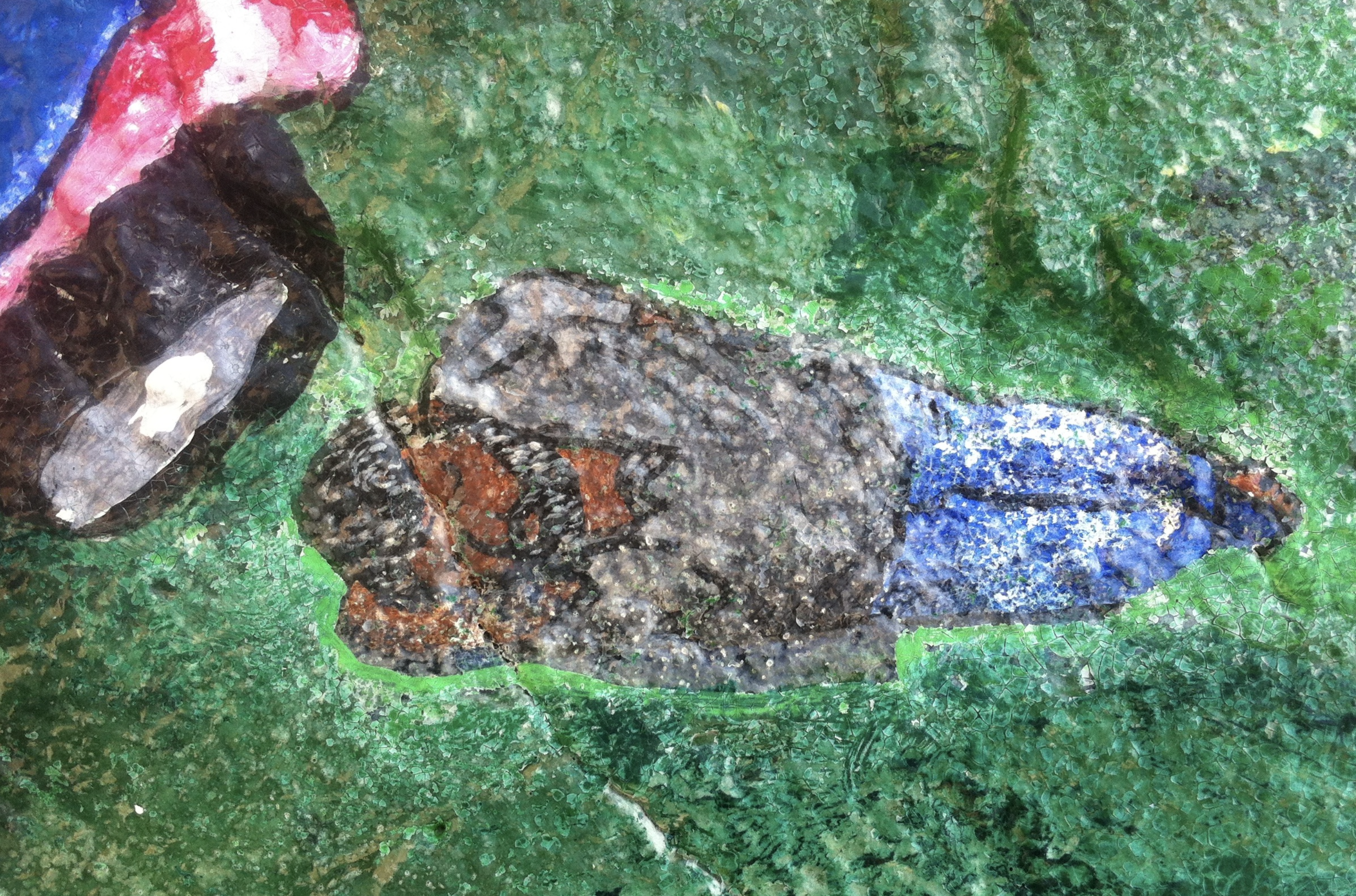
I was immediately nervous. It was clearly a homeless person…a drag worm.
But I didn't want to say that.
What was he doing?
Trying to goad me into a fight?
What was his point?
I didn't say what I was thinking…I just said I didn't know.
Before I could anything else, he responded back.
“Its me! It's me, man…LOOK!!!!”
And sonofabitch…it was. It was him. Not only that, but the other guy was also drawn into the mural…standing half hidden, behind a column at the Capitol building.
The tension broke.
These guys weren't trying to do anything more than show me how proud they were to be in this mural.
For all I knew they just stood close by every night, so they could tell their story to unspecting art lovers.
This broke open an extended conversation about the world. They both slammed the Reagan Administration, for not helping the poor. As a Reagan voter at the time, I just listened.
I can't honestly recall how the conversation ended, or what else we said. It was probably forty years ago, from around this moment right now. But that encounter stayed with me. As I said, it was an early exercise in not “Otherizing” homelessness or houseless neighbors.
I do have one more memory of PeeWee. And it factors into why I wrote the song.
Sometime soon after this, there was a homecoming parade, or something like it…up The Drag. One frat had a big trailer as a float, with a big, oversized throne-chair in the middle. And there, in the chair, drunk out of his mind, was PeeWee. They'd declared him King of the Parade, and provided a keg of beer by his feet, from which he was clearly partaking.
Again, this stayed with me. I was horrified at the way they were poking fun at him, even if he clearly loved the attention. This became a seminal moment in my adopting a more progressive social view, and realizing just how deeply we Otherize and dehumanize people. (ALL. OF. US.)
So, the song came out sometime after this.
Those who know me in the present day know that each winter on sub-freezing nights, I now drive our church van around Oak Cliff and Dallas, picking up houseless neighors.
I think of Peewee every time.
BTW…back the mural…and a final heartbreak….
Sometime later on a visit to Austin, I discovered that: PeeWee image has now been painted over. He's gone from the mural. Not sure why or when. But it's gone.
This is heartbreaking. But, somehow, rhymed too. In the present-day, far too many just want the problem to disappear…or to offer simplistic solutions that a middle class person, living with walls, a roof, and central AC, think are “obvious.”
But it's NOT obvious. The problems are chronic and hard, and if it were easy, we'd have fixed it, already.
The issues of are complicated, for sure.
Our houseless neighbors are human beings, not just stories to be erased.
They have stories, like this one I have just told.
It's possible to have connection with them, beyond seeing them as a nusance.
I know…I really do know…the solutions are complicated.
I never did one thing to really help PeeWee, except write this song.
But I try to do what I can now…and maybe we call can do a little more?
Production:
This song dates to Alpha/Omega. I sing the harmony vocals.
That's Reggie Rueffer, from that same incredible session I already described.
And that's Tim McLemore on that same ivory grand piano.
Nothing has been added/altered from the demo Clark worked up…just mastered.
My voice is mixed a bit low. I tried to double-track it, but couldn't get it to sound decent.
So, it is what it is.
And I think, at least musically, it's haunting and perfect.
Stepping On Your Feelings (lyrics)
This is the last of three songs, inspired by Dr. Friedman. Like the others, it's based on one of his fables, this time titled, “A Nervous Condition.” Like the other songs, I've lifted some of the concepts. In the story, a man named John has a “nervous condition,” through which all the nerve endings of his body on the OUTSIDE. They trail after him, across the floor.
As such, nobody can ever get close to him. Everyone treats him with kid gloves, at a distance, afraid that they might “step on his feelings.”
He eventually marries a woman who mostly does so out of pity that devloped into love. But one day, even SHE can't take it, any more. And instead of moving out of his way, and coddling…she STOMPS on the ganglia. He retreats and runs away, shocked that she would be so “cruel.” She follows him around the house, with years of pent-up frustration, stomping down on his “feelings.”
The next day, she awakes to find that he now looks like a totally normal person.
The ganglia have retreated inside of his body.
We are, right now, having a cultural moment were “Empathy” being hotly debated. There are pastors who cite the work of Friedman, and might even cite the moral of this story as reasons for being anti-empathy. I won't go into any of that, here. Except to say: I think they are misreading Friedman…and i did write a long essay about it, that you can read here.
If you are intersted in understanding how some Christians claim to be anti-empathy, this critiques some of their misreading of Freidman in a way you might find interesting.
The bottom is that empathy IS real. And if you want to argue that, then at least “compassion" is real, and this is what more ordidnary folks mean by empathy. Compassion, whatever you think of empathy, is a term thousands of years old, at the heart of every great historic religious tradition…including Jesus' teaching.
That said, it is true that empathy alone won't get us all we need for actual human relationships.
Sometimes we need empathy.
Sometimes we need to be pushed.
All of us need both.
We also all need spaces where don't have the fear of being accused of “stepping on” somebody's feelings, and instead just have actual, honest exchanges with each other.
In other words, I tend to find fault with the anti-empathy crowd.
But, I also agree with Friedman that empathy is never enough, if we're really going to have real relationships with people.
In our society today, it seem to me that everyone, regardless of politics or social views, are demanding that everyone else respect and mind their “feelings.”
Friedman would suggest this but a symptom. This indicates what he'd call the “regressive nature” of our current cultural moment…and he saw it coming, back in the 1990s.
From parents coddling children…fearful of their every move…to almost every societal conversations, there seems to be a demand for the feelings of others to be accounted for…and like the story, too often it's used as a way to silence debate, or and distance others. And trust me, I'm a feeling-based guy, at heart. But I know enough to know that approach has a limit.
I don't know how we get out of this.
But I know that we're better off dancing with our partners, than we are frozen in the fear we will dispect the other's feelings.
Let's hope for a world that is more evolutionary, than regressive…that dances, rather than tip toes.
We need that.
Production:
Original guitar/vocal tracks, and Kevin Moore on bass, were recorded with Clark at Phatman, with Bruce Hathaway on background vocals later at Alpha Omega.
I couldn't really ever get Clark to understand the slight tempo changes I envisioned here….so I just finished it with guitars and percussion, added by me recently here at Selfish Giant.
No Greater Wound (lyrics)
I wrote this around the time I started working on “the second record that never came out.” I was starting to take care of my own physical health, think about losing weight, etc…I weighed 300 pounds. Setting up “Selfish Giant Studios” was part of that journey at that time.
And I was already lamenting the songs-not-released from the first record that never came out (2004), and how I'd really stopped myself, more than anything. Nobody else did it to me…I did it to myself.
Your mileage may vary, but for me the greatest “stopper” to myself is…myself.
The biggest challenge I often face is: getting from “thoughts inside my head,” to “action in the real world.” For me, it's the journey of a million miles, from the inside of my head, to action in the world. It's as real as any physical “hero's journey.”
(I'm an Enneagram Four, which will explain this for some….)
“Just do it.”
So, I am my own biggest critic. And the interior critic is what keeps me frozen, almost always. (I tried to poke fun at this with “The Don't Shop” on the last record…). The great Dana Cooper wrote a more positive version of all this with his remarkable song “Standing In My Own Way.” If you have trouble getting inspiration to get out of your own way, check it out too.
Jim is me.
I am Jim.
And the way out of a hole, as our 12-step friends remind us, is to name that you are in one…and stop digging.
Production:
This is the roughest, messiest song on the record.
Lots of goofs and recording snafus.
I could redo it…but I like the rawness of capturing this moment when I first put this down.
Whatever Comes Next (lyrics)
I'd just recenty bought my Santa Cruz guitar, and we'd driven it back across country, from McCabe's in Santa Monica. It has such a rich, deep, sound. I started writing a lot of acoustic tunes, many of which never ended up with lyrics.
This was one.
To me, it evokes the joy and possibility of some new, hopeful moment, where I open to the future.
Like, getting a new guitar….just joy and openness at whatever is to come.
Production:
Selfish Giant.
Nothing Else Matters (lyrics)
This song describes one of my own most fearful moments, during our young married life. Dennise had a very bad car accident, coming back from the lakehouse, on her way to join us at a two-year-old's birthday party (One of Maria's day care friends)
She was t-boned by an older woman who should not have been driving. She was unconscious for some minutes. To this day, she has no memory of the accident. It did indeed take some months for her to recover.
The cops on scene found her purse and phone after she'd already been cut out of car with the “jaws of life.” They called me on her phone, so I picked up, thinking it was her….and annoyed that she was late to the party. When I answered, they realized I was blocks away, and urged me to come pick up the phone/purse from them. at the accident scene.
Yes, I am sure they were being considerate.
But also yes, they probably didn't want to enter it into evidence if I could pick it up.
They told me she was OK. So I didn't think much about it.
But when I arrived, there were flashing lights, everywhere. My heart started pounding, and I was confused. I didn't see her car.
(she was already on the way to Baylor Hospital…)
I asked the police “Where is her car?”
The pointed to an urecognizable piece of twisted metal, with dried blood, running down the side. I hadn't even recognized it, it was so disfigured.
My knees buckled.
I flew back to my car, my two-year-old daughter, obliviously in the backseat, not at all sure what I'd find at the hospital, given what I'd just seen on the road. I feared thought she might be life-threatendingly injured, based on what I'd just seen.
That ride to the hospital were the single most fearful moments of my life.
The heart of the song is the line is probably also the hardest to hear and even makes me wince:
"When you see the face that feels like home
Although it's been blood spattered
And you can know you won't be left alone
Then there's nothing else that matters."
But…this was how that moment felt, that's what I wanted to capture…that moment when I saw her face in that emergency room, and heard her call out, “I'm Ok….”
That moment of massive relief inspired the whole song. Who knows how much more time we'll have? But each day can be like the end of “A Christmas Carol” if we're paying attention. It's a gift. And only when you've lived through it perhaps being gone do you come to appreciate it deeply.
All this said, as the year's have passed I've realized that atually LOVE is more important even than LIFE.
And if I was re-recording today, I would change that one word in final line.
Production:
“Phatman” studio.
That's Clark playing keyboards in a beautful contra-part.
I'm so grateful to have his keyboard part here.
Me on everything else.
It's Yours (lyrics)
This is me talking to myself, or anybody else, who feels they don't “deserve” their life, or have imposter syndrom.
The best way out of this is to admit:
No, you don't “deserve” the good things that happen to do you.
No, you don't “deserve” the bad things, either.
Your life is just YOUR LIFE.
It just….IS.
So….seek gratitude for it, as gift.
And every day, step into, as Mary Oliver writes, your “one, wild and precious life.”
Because, it's yours.
Production:
Original Tracks…vocals/guitar…background…at “Alpha/Omega” and “Phattman.”
Electric guitars and percussion, me at Selfish Giant.
Return:
So now, a twin-song of sadness/hope, to the joy of “You Can Go Home Again.”
It’s little more one year after I wrote that “You Can Go Home Again” and it’s already become one of my most-known songs.
I’m sure at this point, I've already recorded the tracks you’re hearing on this record, and to me, it describes the hope/optimism of our future….in our truly one-of-a-kind home. I could see that future unfolding. More music in my life. Our amazing house in my life. It was all happening…it felt like roots were being planted, and I started letting myself see a future here.
But still fresh with this, I am now being sent to be the pastor of Northaven UMC.
And they have a parsonage.
And they are telling us we must move there.
And while I am thrilled to be their pastor, I am devastated to move out of our house…AGAIN…especially as the aforementioned song has become something of an anthem for our lives.
This can’t be right, think…
We moved out once.
We moved back…that was the redemption, right?
We tried to negotiate staying a few more years in our house. We said we’d move when Maria was ready for school. Let Northaven be a landlord for a few years, and then we’ll move when she got to first grade. That would have been an amazing “win/win” for everybody, so that we didn’t have to move twice in eighteen months.
But the Chair of the Trustees didn’t want to be landlord.
So…we became one.
And, devastatingly, we moved out of our house…a second time.
Make no mistake, there ended up being many good things about living in that parsonage, and a million beautiful experiences being the pastor of that church. But that one detail, moving away from a place that felt like our destiny-home, that seemed confusing and off, and somehow not the plan.
“Return” comes in that moment.
For many years, I imagined it as a title track for a record that never came out.
It’s a song about “leaving again…how can this be?”
But, it's ultimately a song about hope…trust in some future you can't really see.
Our house spent some years, empty. We had terrible tenants at one point. They wrecked major parts or the house, and we didn’t have enough money to fix it up, but did have ust enough to make our payments; keeping it, like Jeremiah’s field in Anathoth.
But, Dennise promised me we’d keep the house, and that we’d “Return” again.
So, I wrote this song to seal it for the both of us, as a song of HOPE for our own, unknown future.
That happened fifteen years later.
Once again, we were singing “You Can Go Home Again,” moving INTO our house for an unheard of THIRD TIME…and the promise of “Return” came true.
In these challenging times in our world, so that third verse feel like a helpful word for us all:
“Keep looking up,
One hand hold at a time
And you’ll reach solid ground that hard earned
And you shall return.”
Seems like a perfect song to end this record.
“Everything is going to be OK in the end…and if it’s not OK, then it’s not the end.”
Especially right now, maybe we all need that reminder.
Production:
“Phattman.
”
Clark played the keys, and added the strings.
Kevin adds bass.
Thank you, again, for listening to this record, and for being my friends over all these many years….EF
—30—