As a preacher and songwriter, I’m always trying to see patterns. I’ve said for years that I’m very good as seeing the forest, not as much with the trees.
Forest-seeing is little understood in our culture today, it seems to me. We are analysts at heart, and we love to focus on individual trees, bringing laser focus to small things.
But there are forests. There are patterns to human life. There is the health of the whole. There is the SOUL of the whole.
And, if I may, I think I’m occupationally better than most at see those patterns. And, if I may, one of the things that might do us all a little good is to remember this. To remember that at the macro-level there are beautiful and, I think, mystical/spiritual forces that bond us together.
Take my last three weeks, for example. They’ve been frenetic, packed with family and faith-work that is unrelenting. But I got to do two things during that month through which I am seeing a pattern I want to talk to you about today. The moments are:
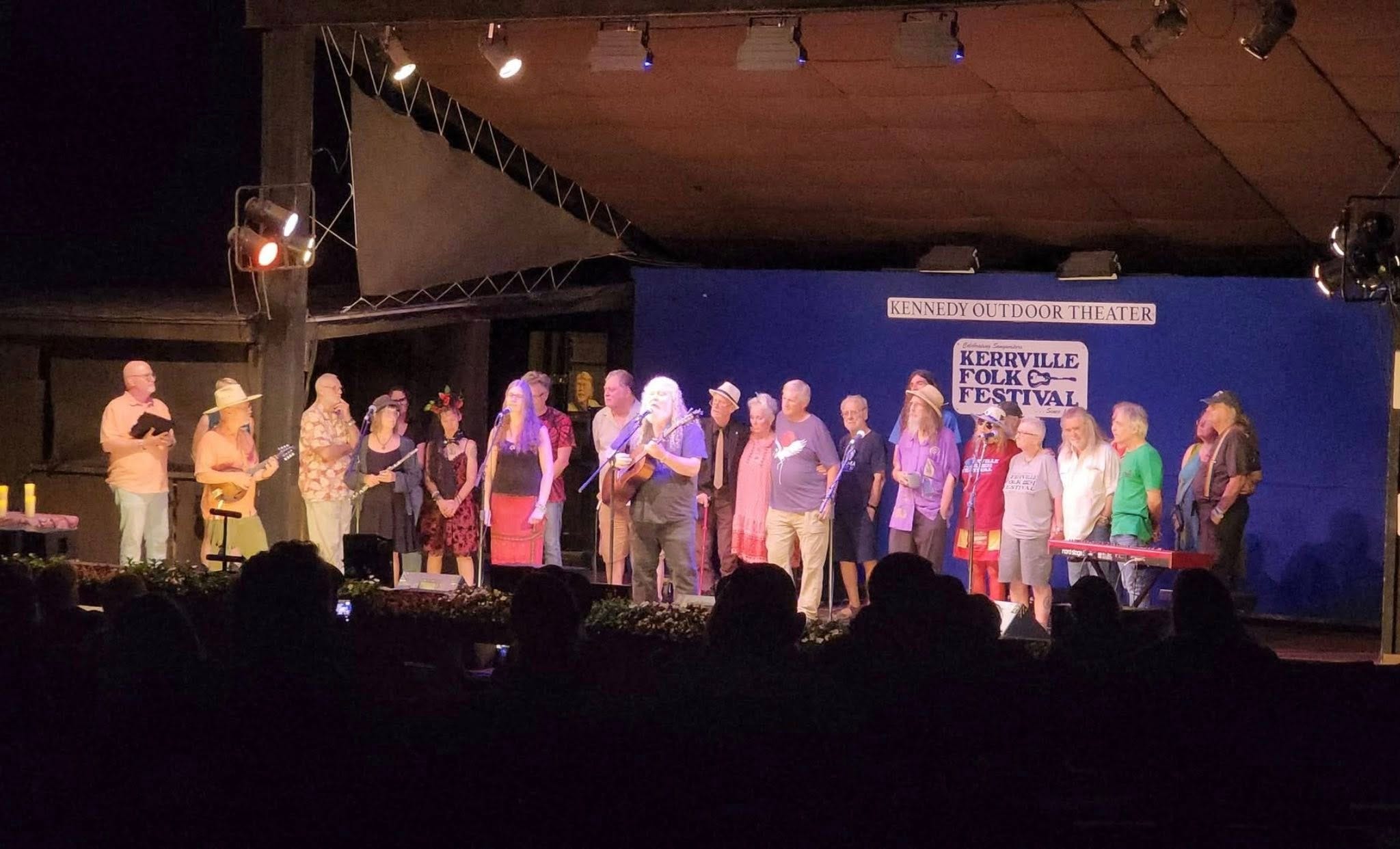
First, I hosted the “Memorial Night” Event at the Kerrville Folk Festival, where as a part we remembered the horror of last year’s July 4th flood.
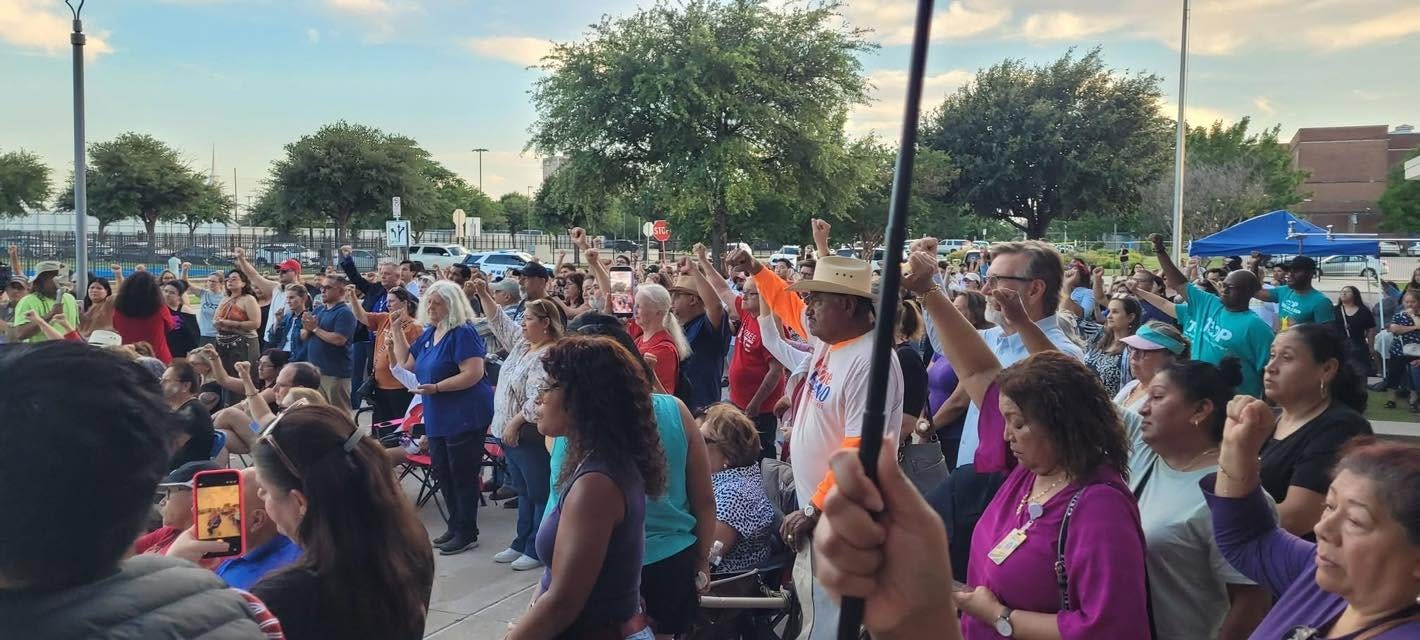
More recently, I’ve been involved in several vigils here in Oak Cliff as we continue to come to terms with the horrific apartment explosion here.
I’m seeing the pattern in these. And the pattern is about hope, resilience, compassion and love. Yes, it’s about basic human kindness and decency, but it’s also about something deeper.
It’s about a kind of human bond all too often dismiss or ignore; a “forest” I think we too often miss.
As I trust you have seen after really every disaster, there is a pattern. Some beautiful and, always, somehow surprising to us happens: Communities come together.
They, come together across idealogical and political lines; social and economic ones. People pitch in. People sometimes surprise even themselves as the fierceness of their volunteerism.
We give money.
We start “Go Fund Me’s.”
We rush to our closest and gather bags of clothing.
We hold canned food drives.
We volunteer alongside people we have never met.
We cook meals and house rescue workers.
We rebuild houses.
We refurnish apartments.
We pray and hold candlelight vigils.
In other words: Time, and time, and time again…in our hardest moments…human beings show a remarkable grace, compassion and love that is somehow missing (so it seems…) in our every day world.
At our Memorial Night in Kerrville, we heard how our beloved folk festival became a rescue hub in the months following last year’s flood. Deb Rouse, and all the staff and volunteers, opened the kitchen to prepare meals. They opened the ranch to those who needed a place to be. They raised $100,000 in relief funds to help those affected.
One story which I did not get to tell due to time involves Ann’s home. Ann is a longtime Kerrvert and member of Camp Inertia. Also for you Methodists: A lifelong friend of Mary Brook Casad through a summer camp there.
In fact, in the immediate aftermath of the flood, Ann was tending to children in their care at the camp. She didn’t even have time to pay any attention to her own home. (Everyone at their camp was physically ok…).
But that meant she couldn’t even get home to check on her own place (which was destroyed…).
Some time later, when she finally was able to get home, she found Kerrville Folk Festival friends and staff already there, helping HER.
She helped kids.
Kerrville friends helped her.
At our vigils in Oak Cliff, we heard of the heroic work of Mission Oak Cliff, mere blocks from the blast site. I saw Anthony, my friend with Dallas For Change, who has been volunteering there.
Anthony lives in East Dallas, near me. And I first met him during freezing nights, when like we do with KPUMC, he drives his van around to pick up the houseless. But, of course, I thought: Even though he lives in East Dallas, Anthony is responding now.
Because: This is what we humans do.
Every Christian pastor is involved in supporting this kind of work, to some extent or another during their “ministry.” For me, I was a “missions pastor” for a half decade; which meant it was literally my specific job to help our members connect and respond in times of crisis.
Evolutionary biologists will tell you that all of this comes from our ancient need to care for the tribe. We learn these behaviors, and carry them forward for the survival of the tribe.
In times like the Hill Country Flood or the Oak Cliff Explosion, the normal tribal separations vanish, for a time; and we see powerful representations of human community.
But this is where, if I may, I think we reach a moment for faith. We reach the moment where my own Christian tradition has something to teach us.
As a practicing Christian for many years, of a progressive form of our tradition, I believe what we are seeing here is the inner meaning of “resurrection” and the outer meaning of what we Jesus called “compassion,” or the heart of love.
In regular times, as I say all the time, we are deeply “tribal.” Moments of crisis could pull us apart in such times. But, often they surprisingly don’t. Instead, we look past the ordinary tribal identities.
Down in the Hill Country, I think it’s fair to say the town of Kerrville has traditionally not been sure what to think of the hippie-ethos of the folk festival. And musicians and fest-goers alike have never been too sure what to think of the town. Each side, we’ve all known for years, kind of looks warily at the other.
But my friend Alan Gann wrote a poem about the time after the flood. He described a time after the flood when, in the Walmart parking lot, it no longer mattered whether your bumpersticker said “Coexist,” or “Out of my cold dead hands.”
There was something deeper uniting us.
We see this in Oak Cliff too. Oak Cliff is far more politically homogenous. But the cultural tribes of race and class are a real thing. As I say many times, in the best of days it’s challenging to live in such an intercultural place…and in all sorts of ways the last few years have not been “the best of days.”
But, again, folks come together.
My faith is that this is not just evolutionary survival instinct. It’s something like a “spiritual DNA” too. I say this with hesitancy because, yes, I am using “DNA” metaphorically here. There is no physical manifestation of spiritual DNA to be found in a gene splice.
But, my faith is that there IS the concept of “death and new life.”
Theologian Marcus Borg suggests this is the best way to describe what “resurrection” is. Jesus’ story is one that describes this. Jesus’ New Life is not the same as his old life. His body functions differently than a normal body (moving through walls…flying up through the sky…)
We are not to take this literally, but to understand that this is how the “forest” works. Inside every death, there are seeds. There are seeds of New Life and new hope. Suffering and misery do not happen *so that* New Life can occur. But New Life —always different from the past— can emerge out of every human tragedy.
When Jesus shows Thomas the wounds in his side, it’s not just a proof-text for resurrection, it’s a message about how resurrection happens. We carry our wounds. In some sense, we never fully recover to our former glory. We don’t magically “get back” our old life.
But, as a Christian, this mysterious process is one I see time and again. And, from my chair, it’s a deeply spiritual one. Whether you ever call it resurrection, or not; whether you see it through that framework, I will trust you have experienced it in your life.
But there is a second, companion spiritual trait we see in times like these, and that is COMPASSION.
Those who know my writing/preaching well know I am obsessed with this concept. That’s because I am absolutely convinced that we Christians deeply, UNDERvalue its importance in our spiritual lives. We all commonly assume Buddhists understand it.
But Jesus did too. And he means us to pay attention to it, and practice it.
The Biblical word for compassion —“Splagchnizomai” in the Greek— shows up several key stories, seminal stories that are among the most important in all the Gospels. I’ve written about this before, and invite you find it here:
This coming Sunday, in the lectionary reading, Splagchnizomai makes one of it’s appearances. It’s the Gospel of Matthew, and the writer of Matthew says this:
“Now when Jesus saw the crowds, he had compassion (splagchnizomai) for them because they were troubled and helpless, like sheep without a shepherd.”
Splagchnizomai means: “to be moved in the inward parts, i.e. to feel compassion.”
It’s deeper and more visceral than heart flutters. It’s literally seated in the GUT…the bowels of the body. When your spirit goes out to any hurting human being, that’s Splagchnizomai. You often find yourself responding in ways you can’t even explain.
It’s that list of spontaneous goodwill I described in the very first part of this essay…all the things…from Go Fund Me-s to bags of t-shirts. And yes, I know (and you should too) that one of the least needed items after a disaster is your bag of old t-shirts.
This is the inside joke for all mission and relief workers. Somehow we human beings feel that a disaster is the perfect time to slough off our smelly old shoes and shirts.
(I even joked with Gannon Sims about this last week; who confirms: Yes, Mission Oak Cliff has waaay too many t-shirts…)
But understand this: There is a beautiful spiritual force behind this.
You don’t know what to do.
You just know you must do something.
So, you bag up those worn out, smelly, concert shirts, and send them along.
This, friends, is the heart of Splagchnizomai; because it’s a spontaneous and HUMAN act, beyond conscious thought.
You just say to yourself, “I just had to do something…”
Soon enough, our tribal natures return. Soon enough, those cars with different bumper stickers find themselves arguing politics again. Soon enough, we re-divide by politics, race, and class.
And this is when we need Jesus.
Right at that moment.
This is the “WHY” behind Christian worship, and Bible study. This is the “WHY” behind our Methodist desire to combine public worship, prayer, and service.
BECAUSE…we are tribal.
But our faith is supposed to teach us how not to be.
Jesus’ Gospel message is about demolishing our tribes. Eviscerating them. Demanding that we see all persons as God’s beautiful children.
Yes, this is paradoxical. There is no more lethal tribe in our cultural today than Christian Nationalists….seeking to enforce a Theo-political system on us all.
But deeper than them are the real teachings of Jesus about tribe. And from his mission statement in Luke 4, to the day of his death, Jesus is demanding that the religious, the non-religious, and everyone in between look beyond their own tribe and see everyone as God’s child.
This is not our every-day nature. The every-day nature is TRIBAL by race, politics, gender, class…and a zillion other cultural dividers. These dividers can be celebrated as a part of our beautiful diversity. Or, they can be driven like wedges into the hearts of neighbors and friends.
Our tribes have their own rationality and purpose. But in a multicultural world, they can often distance us from each other, and cause distrust and hatred to grow. Some of us…especially White people…fail to realize that we even HAVE a tribe. We’re so clueless about it, we just assume our experience is “normal.”
Again, this is where Jesus’ concept of Splagchnizomai comes in.
Jesus calls us all to deep-level compassion for every person.
It’s the way we are supposed to live each day, but don’t. So we come back to worship each week to, as Mr. Wesley said, learn how to be “more perfect.”
We practice faith.
We trust we can improve, and we don’t assume we have arrived as the fount of all knowledge.
This, friends, is HARD WORK.
Faith, actually, is hard work; because Jesus demands we love past the walls that divide us.
We would never wish a Hill Country flood or an apartment explosion on anyone. But when they come, they give us some glimpse of what we Christians call “beloved community.”
At the Kerrville Folk Festival, there is a sign at the exit/entrance. It’s been there for years. Whether everybody knows it or not, it’s a faith statement:
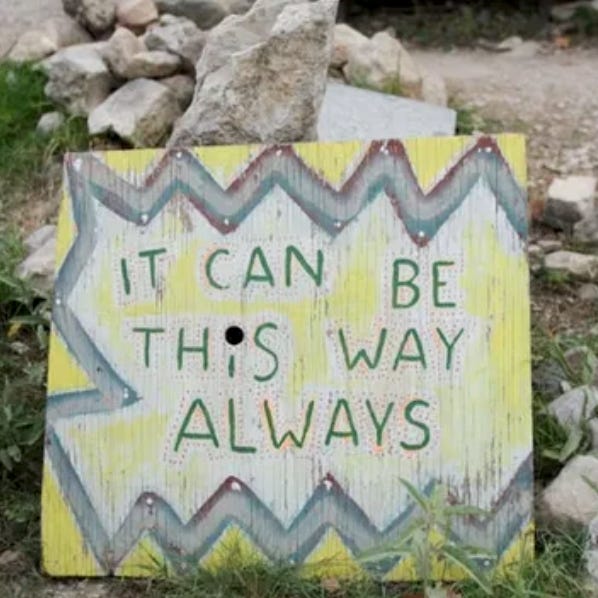
“It can be this way, always.”
This is the truth that spiritual mystics and artists know. The every-day world that always intrudes isn’t all there is. There’s a “something more.”
In music, commercialism can creep in and spoil.
In church, the politics of the faith and the nation do.
But, both the festival and our faith say: “It can be this way, always.”
Of course, it’s not.
We forget the magic of the festival, all too soon.
We leave Sunday worship and immediately curse out some driver that cuts us off.
The real world crashes back in.
But in a very real sense, this is also what we’re saying at church each week.
We gather to remind ourselves that Jesus loves us, and that Jesus loves everybody. We read stories of how Jesus “has compassion” for a miserable group of followers who probably got themselves into their own mess. We read how he feeds the hungry, clothes the naked, and tells us to do the same. We practice compassion because none of us are very good at it.
And then, after we’ve heard such lofty tales, our benediction is a kind of ““It can be this way, always” moment.
“Go back into the world,” we say, “remember what we learned today…
Through faith…through hope…through a life of practiced compassion…we can come to believe what the world tell us cannot be:
It can be this way, always.